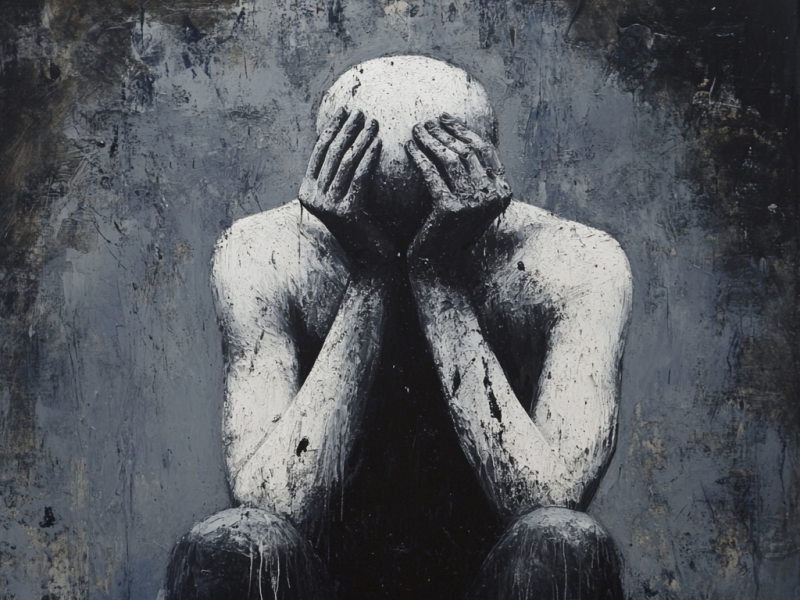
Emotional blunting is not a fringe psychological condition or a rare clinical symptom, but a widespread social state. In a culture defined by constant stimulation, perpetual crisis, and relentless performance, emotional flattening is not an anomaly but an adaptation.
At a societal level, emotional blunting emerges when people are asked to absorb more than they can metabolize. Endless news cycles, algorithmic outrage, economic precarity, social fragmentation, and digital immersion create a constant low-grade emergency. The nervous system was never designed to process this volume of threat, comparison, and abstraction without consequence. One of the most common consequences is emotional shutdown.
What once might have been diagnosed as disengagement, apathy, or depression is now so widespread it barely registers as abnormal. People still work, socialize, post, consume, and comply, but often without genuine emotional presence. They react on cue, express opinions reflexively, and perform empathy in public spaces while feeling very little privately.
This is why emotional blunting is difficult to detect. A blunted society still functions. But beneath the surface, emotional depth erodes. Joy becomes shallow, grief becomes delayed or displaced, and moral responses become abstract rather than felt.
In such an environment, numbness is not laziness or weakness, it is an understandable response to saturation.
Modern life rewards detachment. Productivity culture values output over meaning. Social platforms reward reaction without reflection. Political and cultural systems demand constant attention while offering little agency. People are encouraged to care loudly and move on quickly, to process tragedy in headlines and forget it by the next scroll.
Over time, this conditions people to disengage emotionally as a survival strategy. Feeling deeply becomes inefficient, destabilizing, even risky. Emotional blunting allows individuals to remain functional in systems that do not slow down, do not grieve, and do not repair.
The result is a population that is informed but unmoved, connected but detached, and constantly stimulated yet internally hollow.
A blunted society loses more than feelings, it loses judgment, empathy, and accountability. When emotions are muted, so is the ability to recognize harm, respond proportionally, or sustain moral concern. Suffering becomes content. Violence becomes background noise. Injustice becomes familiar.
Emotional blunting weakens social bonds. Relationships become transactional. Communities fracture into performance and identity rather than shared experience. Without emotional resonance, trust decays, and without trust, collective action becomes nearly impossible.
This numbness also creates fertile ground for extremes. When people feel nothing, they seek anything that cuts through the fog. This could be rage, spectacle, cruelty, or tribalism. The search for sensation replaces the search for meaning, accelerating polarization and instability.
Societies rarely collapse all at once. They erode slowly, through disengagement, indifference, and emotional withdrawal. Emotional blunting contributes to this erosion by reducing the capacity for sustained care. People stop believing their feelings matter because the system does not respond to them. Eventually, they stop feeling at all.
When emotional life becomes flattened, ethical life soon follows. It becomes easier to tolerate dehumanization, easier to ignore suffering, easier to accept decay as normal. A numb population is easier to manage, easier to distract, and harder to mobilize toward repair.
Addressing emotional blunting at a societal level requires more than individual self-care. It demands structural change: slower information environments, restored community spaces, economic conditions that allow psychological safety, and cultural norms that value depth over performance.
Feeling again is not about intensity or sentimentality, it is about restoring emotional feedback. Allowing joy, grief, anger, and care to register long enough to inform action. Without that feedback, societies drift. With it, they retain the capacity to correct themselves.
Emotional blunting is not just a mental health issue, it is a cultural warning sign. When a society goes numb, collapse does not announce itself with chaos.